Product
How to Integrate a Payment Gateway for a Nigerian Startup: A Practical Guide
For a Nigerian startup, accepting payments is more than a checkout feature. It is a critical part of the customer experience, business operations, and long-term growth strategy.
Whether you are building an e-commerce platform, a SaaS product, a digital marketplace, or a service-based business, your customers need a convenient and dependable way to pay.
A poorly integrated payment gateway can lead to failed transactions, frustrated customers, lost revenue, and operational challenges. A well-integrated gateway, on the other hand, makes it easier for your business to collect payments, reconcile transactions, and scale.
So, how do you integrate a payment gateway into your startup?
Here is a practical guide.
1. Understand your startup's payment needs Before choosing a payment gateway, identify the payment requirements of your business. Different business models have different payment needs. ▪️ E-commerce businesses: Need card payments, bank transfers, and reliable checkout experiences. ▪️ SaaS businesses: May require recurring payments, subscriptions, and automated billing. ▪️ Marketplaces: Need to manage payments from customers, transaction tracking, and potentially payouts to vendors. ▪️ Service-based businesses: May require payment links, invoices, and dedicated virtual accounts. ▪️ Fintech startups: Often require reliable payment APIs, transaction processing, and seamless integration with other financial services.
Understanding these needs helps you select a gateway that supports your business model rather than forcing your operations to adapt to the limitations of your payment provider.
2. Choose the right payment gateway Not all payment gateways are built the same way. When evaluating providers in Nigeria, consider:
▪️ Supported payment methods, including cards and bank transfers. ▪️ Transaction success rates and reliability. ▪️ API documentation and developer experience. ▪️ Transaction fees and settlement timelines. ▪️ Security and regulatory compliance. ▪️ Customer support and technical assistance. ▪️ Scalability as your transaction volume increases.
The cheapest gateway is not necessarily the best choice. A provider with lower fees but frequent transaction failures could cost your business more in lost revenue. Your payment infrastructure should be evaluated based on the value it delivers, not just its pricing.
3. Prepare your business for integration. Once you have selected a gateway, the next step is to prepare your platform. Most payment gateway integrations require the following:
▪️ A registered merchant account. ▪️ Business verification and required KYC documentation. ▪️ API keys for testing and production. ▪️ A website, mobile application, or backend system. ▪️ A secure server environment. ▪️ A designated settlement bank account.
Your startup's technical team should review the provider's API documentation to understand how payment requests, transaction verification, and notifications work.
4. Integrate the payment gateway into your platform. A typical payment gateway integration follows a straightforward process.
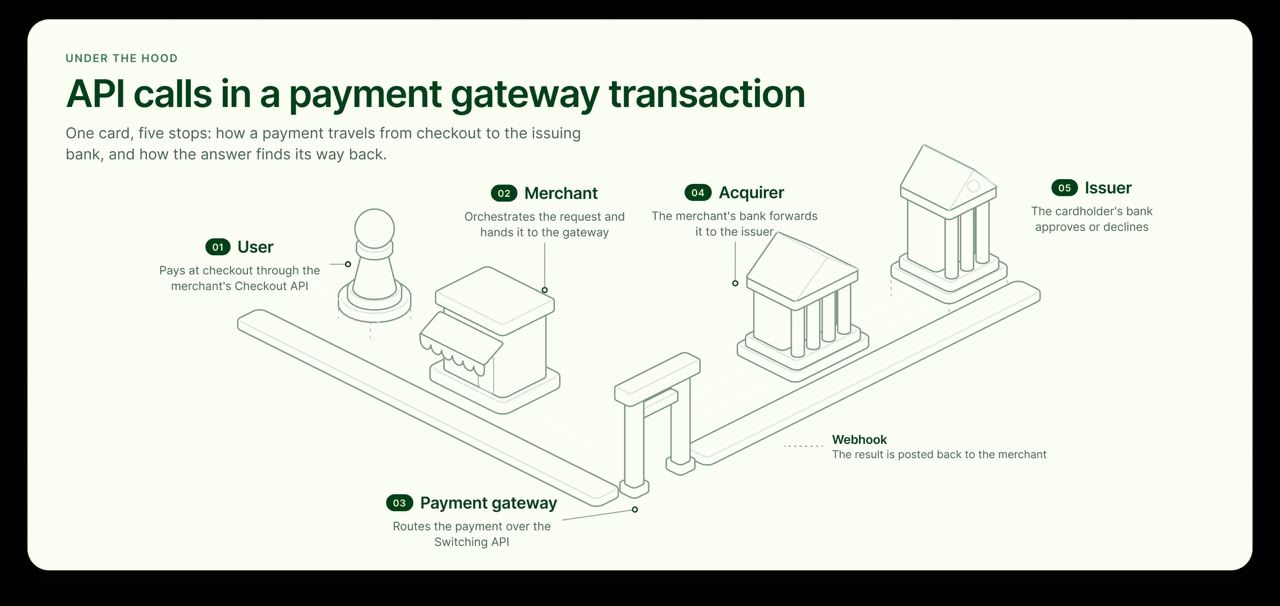
The Payment Flow ▪️ Customer initiates payment: The customer selects a product or service and proceeds to checkout. ▪️ Your platform creates a payment request: Your backend sends the transaction details, including amount, currency, and reference, to the gateway. ▪️ Customer completes payment: The customer pays through the gateway's supported checkout methods. ▪️ Gateway processes the transaction: The payment provider communicates with the relevant financial networks to process the payment. ▪️ Transaction is verified: Your backend confirms the transaction status through server-side verification and/or a trusted webhook. ▪️ Your platform fulfils the order: Once payment is confirmed, your system updates the order, generates a receipt, and delivers the product or service. ▪️ Settlement and reconciliation: Funds are settled according to the provider's settlement terms, while your business reconciles the payment against its records.
An important technical consideration: never rely solely on the customer's browser redirect to confirm payment. Your backend must verify the transaction independently. Webhooks should be authenticated, and your system should be designed to handle duplicate notifications without processing an order twice.
5. Test before going live. Testing is a critical part of the integration process. Before launching, your team should test: ▪️ Successful payments. ▪️ Failed and declined transactions. ▪️ Incomplete or abandoned payments. ▪️ Duplicate payment attempts. ▪️ Delayed transaction notifications. ▪️ Refunds and reversals. ▪️ Settlement and reconciliation. ▪️ Mobile and desktop checkout experiences.
A payment gateway may appear to work perfectly during a successful transaction. The real test is how it handles everything that can go wrong.
6. Prioritise payment security and compliance. Payment security should be a foundational consideration, not an afterthought. Nigerian startups should evaluate their gateway's security controls and applicable regulatory obligations, including: ▪️ PCI DSS compliance for card payment security. ▪️ Encryption of sensitive information. ▪️ Fraud prevention and transaction monitoring. ▪️ Secure API authentication. ▪️ Data protection and privacy requirements. ▪️ Relevant CBN regulatory requirements.
The CBN lists Belema Financial Technology Limited among switching and processing licence holders.
Your business should also understand its own compliance responsibilities. Using a payment gateway does not automatically eliminate every obligation that applies to the merchant.
- Monitor payment performance after launch Integration is not the end of the process. Once your gateway is live, monitor its performance regularly.
Some important metrics include:
Regular monitoring helps you identify issues early, optimise the checkout experience, and make better decisions as your startup grows.
The TRUST Framework: Choosing the Right Payment Gateway
For Nigerian startups, selecting a payment gateway should go beyond the ability to accept payments. The infrastructure must be dependable, secure, and capable of supporting business growth. This is where Belema Fintech's TRUST framework provides a useful evaluation model.
T - Tested at Scale Choose infrastructure with the capacity to process transactions consistently, even as your business grows. Evaluate transaction volumes, performance under load, and proven operational capability.
R - Reliable Your payment gateway should minimise downtime, handle transaction failures gracefully, and provide dependable payment processing and support.
U - Unified A gateway should support seamless integration with your existing systems, payment channels, applications, and business processes through flexible APIs.
S - Secured Protect customers and transactions through robust security controls, encryption, fraud prevention, and applicable compliance standards.
T - Transparent Understand transaction fees, settlement timelines, transaction statuses, reporting, and reconciliation without hidden surprises.
The TRUST framework helps startups assess payment infrastructure through five essential considerations: performance, reliability, integration, security, and transparency.
Why BelemaPay is an Ideal Payment Gateway for Nigerian Startups Having understood the requirements for integrating a payment gateway, the next question is which provider can support your startup's payment needs today and its growth tomorrow?
BelemaPay is designed to provide businesses with secure, scalable payment processing and flexible integration capabilities. Its payment infrastructure supports online and in-person transactions, alongside custom integrations. Here is how BelemaPay aligns with the TRUST framework.
▪ Tested at Scale:
 Belema Fintech provides payment infrastructure for businesses and financial institutions, with solutions designed to support growing transaction demands.
▪ Reliable:
 Belema's infrastructure is built around dependable transaction processing, operational continuity, and seamless payment experiences.
▪ Unified:
 BelemaPay offers API-based integration, enabling businesses to embed payment functionality into their platforms and applications.
▪ Secured:
 Belema Fintech highlights PCI DSS compliance and ISO 27001:2022 certification among its security credentials.
▪ Transparent:
 BelemaPay provides transaction processing and financial management capabilities that help businesses track transactions and manage collections. Startups should confirm the applicable pricing and settlement terms before onboarding. Belema Fintech +1
For a startup looking to integrate payments without losing sight of security, operational efficiency, and scalability, BelemaPay presents a compelling option. It provides the payment infrastructure your business needs to focus on what matters most: building products, serving customers, and growing revenue.
Conclusion Integrating a payment gateway is one of the most important technical and business decisions a Nigerian startup can make. The right gateway does more than process transactions. It builds customer confidence, supports business operations, and creates a foundation for growth.
By understanding your payment requirements, choosing the right provider, implementing secure integrations, testing thoroughly, and monitoring performance, your startup can build a payment experience that customers trust.
And when evaluating your options, let TRUST be your guide.
Ready to integrate?
Explore BelemaPay and discover payment infrastructure designed to support your business.